
Tyre Pressure: Why It Matters More Than You Think
Tyre pressure is the cheapest maintenance you will ever do — it costs nothing and takes five minutes — and it is the one most drivers skip until something feels wrong.
Tyres lose pressure naturally, roughly 1-2 PSI a month, and faster in cold weather. A tyre can be significantly under-inflated and still look completely normal.
What happens when the pressure is wrong
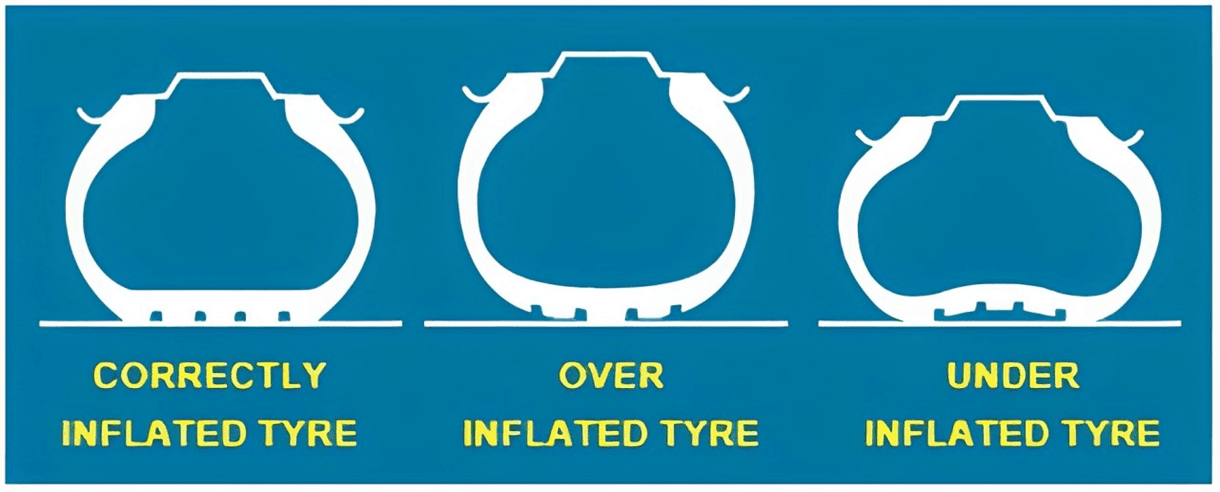
The diagram above shows why. A tyre only touches the road across a small contact patch, and pressure determines its shape.
Under-inflated, the tyre sags and the contact patch shifts onto the outer shoulders. The centre lifts away from the road. You get:
- Accelerated wear on both shoulders
- Higher rolling resistance, so more fuel and less EV range
- More flex in the sidewall, which builds heat — the main cause of blowouts
- Vaguer, slower steering response
Over-inflated, the tyre crowns and rides on its centre band. You get:
- Rapid wear straight up the middle of the tread
- A smaller contact patch, so less grip in the wet and under braking
- A harsher ride, and more damage from potholes
It changes how the car handles
Pressure is not just a wear issue — it changes the balance of the car.
Low pressure at the front tends to push the car towards understeer: you turn the wheel and the car carries on straighter than you asked. Low pressure at the rear tends towards oversteer, where the back of the car steps out.
Neither is something you want to discover mid-corner in the rain.
How to check it properly
Check cold. Driving heats the air inside and raises the reading, so check before you set off or after the car has sat for a couple of hours. If you must check warm, expect a few PSI over.
Use the vehicle's figure, not the tyre's. The number moulded into the sidewall is the tyre's maximum, not the recommendation. The correct pressure is in your handbook and usually on a placard inside the driver's door shut or behind the fuel filler flap.
Watch for a loaded figure. Most cars list a higher pressure for a full load — worth using for holidays or a heavy boot.
Do all five. Including the spare, if you have one. A flat spare is no spare.
A note on TPMS
Most cars registered since 2014 have a tyre pressure monitoring system. It is a useful backstop, but it is not a substitute for a gauge — many systems only warn once pressure has dropped around 25% below target, by which point you have already been driving on a soft tyre for a while.
If the warning light comes on, do not just reset it. Find out why.
How often?
Once a month, and before any long journey. It takes less time than queueing for the pump afterwards.
Pop in and we will check your pressures and tread for free — no appointment needed. We are on Longley Lane in Northenden, find us here.